I have already stated in a past posting that by law all sheep have to be tagged. Those destined for pies just require one tag, those destined to remain on farms as breeding sheep require two tags.
If a sheep is found to have lost a tag the farmer is required by law to replace that missing tag or pair of tags.
Now I have my ears pierced and over the years I have lost many earrings out of my lugs. Pull your jumper off over your head and hey presto! gone, left with just one lug ring, t'other never to be seen again, mainly due to the fact that it generally takes me days to realise I lost one in the first place.
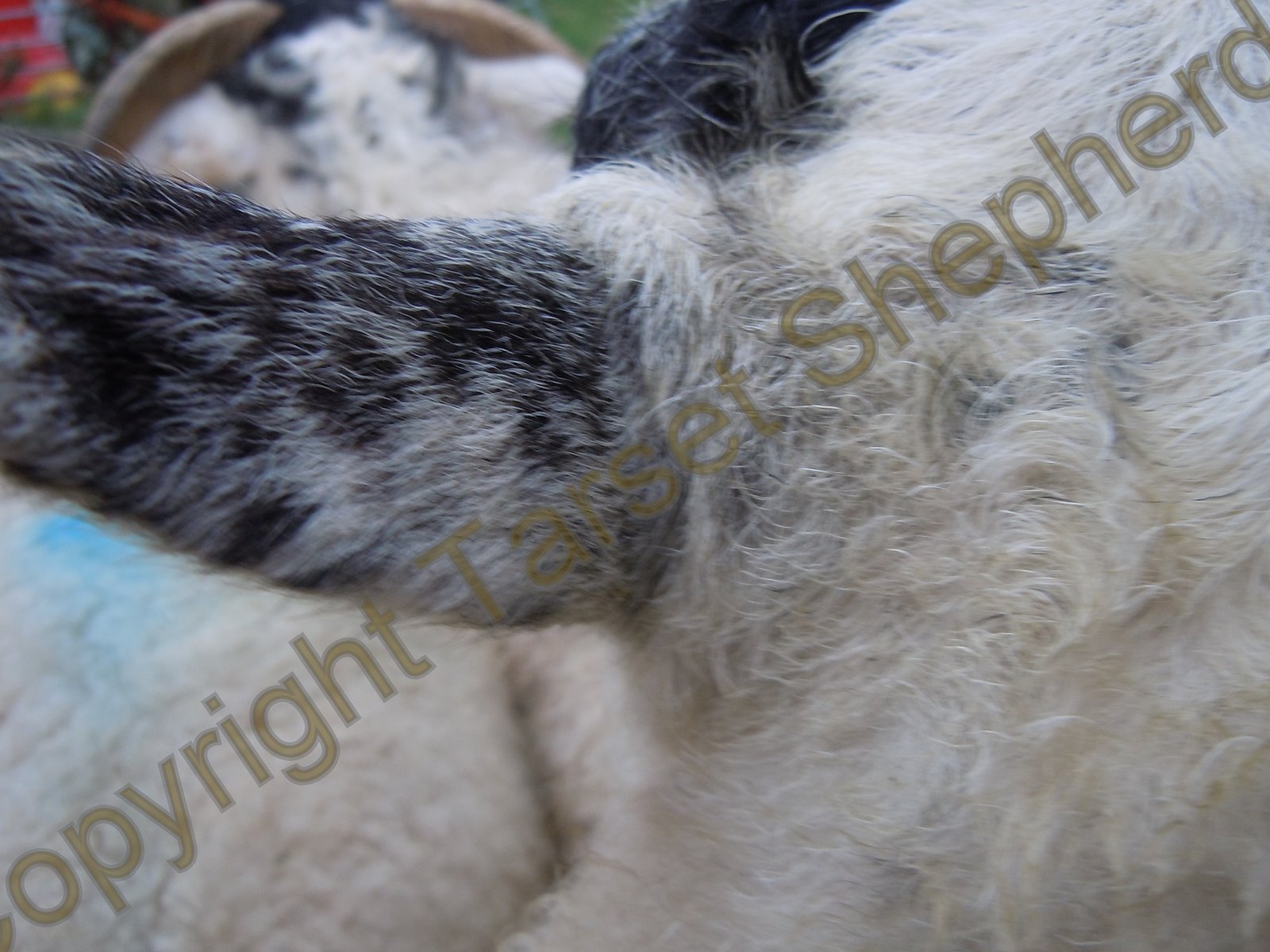
So sheep don't pull their jumpers off over their heads so they won't have the problem I experience, they just have other problems. Sheep have wool and it can indeed get tangled on their person, they also like to stick their heads through wire fences, they like to feed at hay hecks, they traipse through heather, lie down in dense undergrowth, wander into woods, rub up against things including each other, especially when in the sheep pens. They have a hundred and one ways of managing to lose a tag. They also have the trouble of flies, which irritate them, make them flick their ears around, scrub their heads, kick up with their hind feet - anything to dislodge the pests. I Know! I take some strange photos! The above is an ear, a sheeps ear no less, a normal ear, a healthy ear, it is the last one you're likely to see on this posting - be warned! Blackfaced sheep are not meant to have droopy, floppy lugs. Their ears ought to be pinned back behind their horns and pointing skywards not drooping forwards. This poor soul had little option but to hang a lug. Having been tagged a year previous she had been doing well, until there was some warm steamy weather and headflies became a problem, her incessant flicking of her ears against her horn would cause the skin to break, the headfly would then get excited to a feverish pitch, she would flick her ear even more and before she knew it she had a very sore and very infected ear. This sheep had also been bothered by flies, the tag is actually still in the ear, just encrusted with infection. Was this sheep luckier? She has lost her tag, it has ripped her ear, probably she caught it on something and tore it away from the flesh of her lug which it was pierced through. Unlike the earrings which I wear, which have a removable back her earring is meant to be a permanent fixture, it won't come to pieces, it will come out in one whole piece - torn or ripped out, She had obviously had an infection as well, the hair missing off her ear says it all, although healing up nicely she will have had a rough time of it. Another who had lost a tag, healing nicely? Upon closer inspection there is obviously still a fair amount of infection in the ear, I wouldn't like my lugs to be oozing puss like that. Who would be a sheep hey?
So? Is tagging a welfare issue? It most definitely can be, and unfortunately it is the responsibility of the farmer not those who lay down the regulations to ensure their sheep don't suffer from welfare issues.
When noises have been made it is the farmer who is told he doesn't do the job correctly, it is the farmer who foots the bills for the antibiotics and replacement tags, it is the sheep which can suffer and once ears are healed find themselves having a replacement tag re inserted into their ears, they will have no peace from the dreaded tag until they are dead, and even then, they must have a tag in their ear for the dead cart to collect them.
Maybe our sheep ought to join the maasai people?
Homepage >Blog
Showing posts with label EID. Show all posts
Tuesday, 3 April 2012
sheep tagging - a welfare issue?
Labels:
ailments,
EID,
sheep,
sheep tags,
shepherd,
shepherding,
welfare
Sunday, 26 February 2012
In The News
There has been much for the farming papers to report about recently. A new record price for a limousin bull, sold at Carlisle Auction Mart a week past Saturday for £120,000 guineas. Guineas are no longer legal tender in the UK but there is still a tradition of selling pedigree animals at auction for guineas, a guinea equates to £1.05, therefore the said animal actually realised a price of £126,000 – very nice too! See for yourselves in the following link http://youtu.be/l8mwhbkMCWY?a
The Scottish farming press have also reported this week that German farmers may well be on the way to doing all British sheep farmers a great favour. It would appear that the Germans are prepared to file a law suit with regard to EID. That being the electronic tagging which all sheep farmers now have to comply with, an issue that many are opposed to, but no one seems prepared to fight against. Well, it would appear that our counterparts in Germany are preparing to put up a fight, on the terms of animal welfare and overall financial costs, and rightly so.
It is not just the farming press who are reporting on sheep issues, the national press are also finding livestock issues are hitting the headlines. Long covered by the farming papers since the virus first came to notice last back end, our national press have now picked up on the story. A worrying one for sheep farmers.
It doesn’t seem long since our shores were faced with the doom of the Bluetongue virus, another expense for the livestock vector as animals found themselves being immunised against the virus. Similar to todays virus this one also started in the South of our country and was also reportedly transmitted by midges or mosquitoes. It is hoped Bluetongue may be history on our island but has it just given way to allow another virus in?
It can be easy for us in the North of the country to feel far removed from viruses which are causing havoc further South, but it must be soul destroying for those facing these challenges, and who’s to say we won’t be facing them in a month or two? After all, some countries in Europe are already worse hit than us.
By the press reports in all of today’s Sunday newspapers it would seem that mature animals don’t seem to show many symptoms relating to this virus, the symptoms are showing up when their offspring are being born, as yet our offspring aren’t being born, we will have a while to wait to find out whether the midges made it this far north. If lambs aren’t being still born they are being born with deformities such as fused limbs or bent necks, deformities which they will be unable to live with and so are finding themselves being put down (put to sleep – killed).
Deformed lambs are not unheard of, there may be cause for an odd one at lambing time. Still births aren’t unheard of either, again, an odd one may occur. However, by the reports I have read today some of the worst affected farms are seemingly losing up to 20% of their newborn lambs – that is an enormous loss and a huge financial loss at that. A heartbreaking position to be in for those involved. One farmer quoted said he had put down more lambs this lambing time than he has in his farming lifetime – not a good place to be.
Time will tell whether this virus fizzles out or not, how far through our country it has spread and whether there will be a vaccination introduced to treat against it (unfortunately it is reported that it may take at least eighteen months to produce a vaccine). To date it would seem it only affects sheep and cattle (and possibly goats).
The Scottish farming press have also reported this week that German farmers may well be on the way to doing all British sheep farmers a great favour. It would appear that the Germans are prepared to file a law suit with regard to EID. That being the electronic tagging which all sheep farmers now have to comply with, an issue that many are opposed to, but no one seems prepared to fight against. Well, it would appear that our counterparts in Germany are preparing to put up a fight, on the terms of animal welfare and overall financial costs, and rightly so.
There will be many farmers in this country who will follow the proceedings with interest, farmers who are nervous to speak out themselves about the ludicrousy and cruelty of the regulations which are being enforced upon them. Good luck to our neighbours over the water.
It is not just the farming press who are reporting on sheep issues, the national press are also finding livestock issues are hitting the headlines. Long covered by the farming papers since the virus first came to notice last back end, our national press have now picked up on the story. A worrying one for sheep farmers.
A new virus has hit our shores, carrying the name of Schmallenberg virus it is a relatively unknown entity which is causing stillbirths and deformities in new born lambs away down south. Todays press reports, some of which could be classed as scaremongering, are claiming that up to 70 cases have been confirmed in the south of the country.
It doesn’t seem long since our shores were faced with the doom of the Bluetongue virus, another expense for the livestock vector as animals found themselves being immunised against the virus. Similar to todays virus this one also started in the South of our country and was also reportedly transmitted by midges or mosquitoes. It is hoped Bluetongue may be history on our island but has it just given way to allow another virus in?
It can be easy for us in the North of the country to feel far removed from viruses which are causing havoc further South, but it must be soul destroying for those facing these challenges, and who’s to say we won’t be facing them in a month or two? After all, some countries in Europe are already worse hit than us.
By the press reports in all of today’s Sunday newspapers it would seem that mature animals don’t seem to show many symptoms relating to this virus, the symptoms are showing up when their offspring are being born, as yet our offspring aren’t being born, we will have a while to wait to find out whether the midges made it this far north. If lambs aren’t being still born they are being born with deformities such as fused limbs or bent necks, deformities which they will be unable to live with and so are finding themselves being put down (put to sleep – killed).
Deformed lambs are not unheard of, there may be cause for an odd one at lambing time. Still births aren’t unheard of either, again, an odd one may occur. However, by the reports I have read today some of the worst affected farms are seemingly losing up to 20% of their newborn lambs – that is an enormous loss and a huge financial loss at that. A heartbreaking position to be in for those involved. One farmer quoted said he had put down more lambs this lambing time than he has in his farming lifetime – not a good place to be.
Time will tell whether this virus fizzles out or not, how far through our country it has spread and whether there will be a vaccination introduced to treat against it (unfortunately it is reported that it may take at least eighteen months to produce a vaccine). To date it would seem it only affects sheep and cattle (and possibly goats).
As with many of these viruses (including foot and mouth) it is of no threat to the human race, other than those farmers whose stock are burdened with it, as they have the stress and worry to contend with, both physical and financial. Farmers are resilient souls but for some they and their businesses can only take so many knocks in life, lets hope they can get through this like they've got through everything else in the past.
Labels:
ailments,
EID,
farming,
lambing,
lambs,
schmallenberg virus,
sheep.,
shepherd,
shepherding
Monday, 20 February 2012
tagging sheep. EID
Tags. Destined for sheep, their ears no less. A legal necessity and one thought by many to be an unnecessary necessity.
It often seems that since 2001 the world has gone potty, and probably going dafter by the minute. EU regulations came in force post foot and mouth which required all sheep to be tagged, Traceability was the word used. A single tag with the holding number had to be inserted into the sheeps ear. Eventually it became a single tag with holding number and individual number per sheep.
We are moving on in the world and since 2010 it has been necessary for all breeding sheep to have a double tag. TWO tags, both with the holding number and corresponding individual number, to add insult to injury one of these tags must also be fitted with an electronic gadget.
EID. Electronic identification. Which by law must be done to sheep which are to remain in the flock within 9 months of birth. So it was, Shep found herself tagging sheep and not for the first or last time this year either. Sheep weren't meant to have tags stuck in their lugs, they don't like having tags stuck in their lugs either. Sheep don't have a say in the matter and neither do the farmers seemingly, 'tis the EU who think 'tis good for the sheep industry to spend about 80p on each sheep to ensure it can be traced. There are choices in colours, however the electronic tag is always yellow. As said each pair of tags has an individual number, god help you if you don't concentrate and manage to muddle up the numbers, they must be the same on each pair fitted into each sheep. Should anything go wrong one tag will have to be cut out of the ear and the pair discarded. In the above photo the tag was misfired, finding it clipped together without the ear in the middle, the yellow tag had already been successfully inserted into the ear which meant it had to be cut out. 80p wasted, a cost of £1.60 to tag one sheep. Then there are the tags which fail to work properly, it is sometimes possible to straighten these out again and manage to reuse them, however on this particular day Shep had two which refused to co operate. Another £1.60 down the drain.
All tags used have to be recorded, any found missing are meant to be replaced, more paperwork for the farmers, more expense for them too. Being electronic means they can be electronically read, which is indeed the whole intention, it won't be long before we're not just handling sheep in the sheep pens but we'll all have to have a computer on hand as well.
Sheep destined for slaughter just require one tag. The first thing a sheep loses at the slaughter house is it's head, which includes its ears - how does that then help the traceability of the meat when the tag has been chucked in the bin full of heads?
EID. Electronic identification. Which by law must be done to sheep which are to remain in the flock within 9 months of birth. So it was, Shep found herself tagging sheep and not for the first or last time this year either. Sheep weren't meant to have tags stuck in their lugs, they don't like having tags stuck in their lugs either. Sheep don't have a say in the matter and neither do the farmers seemingly, 'tis the EU who think 'tis good for the sheep industry to spend about 80p on each sheep to ensure it can be traced. There are choices in colours, however the electronic tag is always yellow. As said each pair of tags has an individual number, god help you if you don't concentrate and manage to muddle up the numbers, they must be the same on each pair fitted into each sheep. Should anything go wrong one tag will have to be cut out of the ear and the pair discarded. In the above photo the tag was misfired, finding it clipped together without the ear in the middle, the yellow tag had already been successfully inserted into the ear which meant it had to be cut out. 80p wasted, a cost of £1.60 to tag one sheep. Then there are the tags which fail to work properly, it is sometimes possible to straighten these out again and manage to reuse them, however on this particular day Shep had two which refused to co operate. Another £1.60 down the drain.
All tags used have to be recorded, any found missing are meant to be replaced, more paperwork for the farmers, more expense for them too. Being electronic means they can be electronically read, which is indeed the whole intention, it won't be long before we're not just handling sheep in the sheep pens but we'll all have to have a computer on hand as well.
Sheep destined for slaughter just require one tag. The first thing a sheep loses at the slaughter house is it's head, which includes its ears - how does that then help the traceability of the meat when the tag has been chucked in the bin full of heads?
Labels:
EID,
sheep,
sheep tags,
shepherd,
shepherding,
welfare
Subscribe to:
Posts (Atom)
About Me
- Tarset Shepherd
- Tarset, Northumberland
- A peculiar individual by my own admission. One who has been compared (character wise) with a cheviot ewe!
Recommended Reading
- Woolshed1 blog
An insight into the agricultural heritage of Northumberland and farming in New Zealand, by Dr Clive Dalton - Shepherds Delight blog
Shepherding in the Scottish Western Isles - Dafad's-Days blog
Itinerant observer and thinker
