They are brown and furry with long scaley whip like tails, long whiskers, pointy noses and beady eyes. The good old rat, which Shep has a strong dislike of and which fortunately I rarely come across. Until today that is.
A trip away for the day, towards the coast, to assist the shepherd from out bye to load small bales of hay onto a wagon. It was pissing with rain at home so an ideal day for a jaunt, I was surprised to find we had a terrier to share the journey with us "incase there's rats" was the reply to my query. Oh my god! I'd never considered rats!!
A quick inspection of the stack of hay upon arrival revealed no rat muck (it's similar to mouse droppings but far bigger) there was however signs of a lot of rabbit activity, droppings and later old nests were unearthed but no sign of rats. Thank goodness! Poor ol' terrier was going to have a boring few hours whilst it sat in the vehicle safe from being flattened by bales of hay.
My task was fairly simple, ensuring the flat eight grab had a flat eight of hay to pick up before transporting it to the wagon. Not a stressful job at all and the task was going swingingly until we got close to the bottom of the stack and then...........
A big fat rat ran over my foot. Aargh!!! Now I'm not sure whether it was a wellie clad version of the highland fling or a heavy footed polka but which ever there was a fair bit of louping about went on along with some expletives being uttered, for a split second (or minute or two) Shep lost a bit of her composure. Unfortunately this did not go unnoticed by the shepherd who was on top of the load of hay on the wagon. "Did you get it?"
"Like shite did I"
"what you didn't stamp on it? looked like that was what you were doing?" of course there was a great deal of laughter with this remark as it had been quite apparent that Shep hadn't had the presence of mind to try and kill the not so little blighter and my jumping from foot to foot had infact been a bit of a girlie reaction to a fluffy little creature which shot out and gave me a gliff (fright).
My distaste of rats is well known and the leg pulling continued for the duration of the day. I was offered to swap jobs and hop up onto the wagon to help load it, however my fear of heights is far greater than my fear of rats so the 'kind' offer was duly turned down. Much kicking and tentative moving of bales went on but no further rats came to the surface - what a relief. Mind the fuss I made you'd be forgiven for thinking I'd actually come across a nest of the blighters but thankfully I hadn't, one was quite sufficient for one day I can tell you.
Over the years Shep has many run ins with rats. They are not common on hill farms but lambing sheds can often seem to harbour them and as Shep generally does a night lambing in sheds she finds herself having more than just sheep for company during the dark antisocial hours between dusk and dawn.
I recall being in Leicestershire, lambing a ewe under the artificial electric light of a shed when I had an overwhelming feeling of being watched. Just feet away, sitting under a feed barrier was a plump rat staring at me, me on my hands and knees, with hand up sheeps backside, I stared back, even shouted, but to no avail, the little critter sat there watching the show with glee. Was I relieved when the ewe was succesfully lambed and I could back off. An order for rat poison was put in the following morning.
There was worse to come whilst lambing in sheds in Alnwick years later, there were rats everywhere, even walking along the top rails of the pens, scuttling everywhere they were. I had a veterinary student to work along with and his humour had me jumping everytime as he crept up behind me and emitted a squeak. Didn't matter how I banged buckets, gates or anything else I could lay my hands on it had no effect on the rats - they show absolutely no fear, 'tis left to me to show the fear.
The daddy of them all was a lambing closer to home. There were three lambing sheds which meant traipsing across a shadowy, dark yard to go back and forth between them. I soon learnt wet nights were the worst.
I had no idea what was instore for me on my second night. Sure enough I had seen the odd little 'mouse' scurrying across the yard but nothing to cause any concern, I thought I could smell rats but then there was a lean to shed beside the main lambing shed which housed fattening cattle which were being fed on ad lib silage and barley. You might not know this but silage stinks, far worse than cattle muck it can be quite smelly stuff so I had put down my imaginery rat odour to the feeding of these cattle and was more than happy to stick with this conclusion. I was to learn differently.
To turn the lights on in this lambing shed the easiest access was to head into the outside corner where the cattle shed joined the lambing shed, put your hand up over the top of the wall and switch the light on. I usually crossed the yard without the aid of a flashlight, however, once the shed lights were turned on my eyes were dazzled and so the flashlight would be used to navigate my way around to the gates into the shed.
I merrily trotted into the corner, using the small amount of natural light which is on offer during the night, switched the main lights on in the shed then switched the flashlight on to find my way out of the corner, to find to my utmost horror that there were rats everywhere, I seemed to be standing in the midst of masses of bouncing bodies, ranging from mouse size to almost cat size, how my heart held out I really don't know. I do know I did far more than a rendition of the highland fling and the language would have turned the sky blue if only it could have been seen.
Aargh! Words cannot express my sheer horror, dismay and fear as I scuttled into the lightened shed before standing and studying, looking into every corner and crevice to see where they were. But they weren't.
Unfortunately it wasn't a dream, fortunately though very few of them ventured into MY shed, odd ones would come scuttling in, one even sat on top of the heat box where poorly lambs were placed to keep warm, it was also my 'table' where my bait (sandwich) box and flask lived, I was prepared to die of hunger rather than shoo the little critter away from my midnight feast.
The little mousey things were in actual fact baby rats, they run with backs arched and tails held straight up, actually they seem to bounce rather than run, I studied them often out of the corner of my eye as I crossed the poorly lit yard to the other sheds. I survived by talking to myself, whistling in a nonchalant fashion and keeping my eyes looking forward as I crossed the yard.
There was much jibbering when the farmer arose the next morning and came to see if all was well. The fact he told me he never saw them had me laughing (almost hysterically), they do prefer the darkness of night and I suggested that mebbes he'd like to do the next night shift and see for himself.
To cut a long story short (my stories are always far too long). I learnt a lot about rats during that lambing. They are extremely active on mild wet nights, not so keen on cold frosty night and the hour before day break they go ballistic, I don't know what they do as I never dared look but they get extremely vociforous as though they are having a great big party before settling down for the day. I also know that they grow very big, especially when being fed on ad lib barley, they are also truly carniverous, I didn't know whether to be fascinated or sqeamish when this fact came to light.
Any dead lambs (yes, unfortunately there will be something die on occasion) during the night would be laid outside the front of the shed in the yard. One morning as day light dawned I was stopped in my tracks, frozen to the spot, as I surveyed a carcase I had discarded during the night, it had a woolly lambs body, hairy lambs legs but it's skull was bare to the bone and eye sockets empty, not an ounce of flesh to be seen on the skull of this lamb, I stared with disbelief but there was no doubting what I was seeing. Yards from where I had been working all night, hidden in the shadows of the yard this lamb had been stripped of all skin and flesh from it's skull. It came as a turning point and the rat man was called in, I do believe it was either the rat man in or the lambing man out!
The good old rat has never harmed me, to date I've never suffered any ill effects from working in proximity of them but I really do have an extremely strong dislike of them. They are gregarious, fearless, dirty little critters which I would prefer never to meet and I am so relieved that the night lambing I do in Scotland to date has never seen me have rats for company during the night.
Thursday, 4 November 2010

Saturday, 30 October 2010
Hill farming – its future?
Sheep trade has been good this back end, a huge relief to those who are dependant on sheep production for a living. It is a roller coaster of a ride with many highs and lows, obviously dealing with livestock and natures elements there will be many highs and lows but there are also the pitfalls of economics – money, cash flow.
The sheep sector has had many knocks in recent years, the last being 2007, an outbreak of foot and mouth linked to laboratories in Pirbright and the consequent movement restrictions enforced both nationally and internationally brought about a natural lack of confidence in the industry especially with it being close behind the devastating outbreak of 2001.
When farmers have money they reinvest in their own industry and the many networks which support it, when they don’t have money they tighten their belts, expand their overdrafts and loans and basically baton down the hatches and try to battle through the storm.
So why should the sheep sector have a decent trade this back end? Shep doesn’t fully understand all the elements but I have been lead to believe by press reports that there are far fewer sheep in New Zealand than there were, reports of 3-4million head being dispersed of last year and the probability of more this coming year due to a change in direction towards dairying. Why would New Zealand have any affect on our sales? Imports. There are thousands of tons of New Zealand lamb meat imported into this country every year. If that lamb isn’t coming from New Zealand it has to be found elsewhere.
Elsewhere brings about the question of the strength or weakness of the pound, international exchange rates don’t always provide the returns required to match the demands which then brings in the question of whether exports are viable or not. This leaves the option of the product to be found on your own doorstep - British lamb.
I’m sure there’ll be many other factors influencing the successful sale of fat lambs, such as a smaller lamb crop throughout the country this year due to the inclement weather over the winter and spring and one wholly important factor – the dwindling number of breeding sheep in Britain.
The dwindling number of breeding sheep in Britain. This statement brings me back to the title of this posting Hill Farming - its future?
Hill Farming and hill sheep have always traditionally been the mainstay of the sheep sector in this country. The tough, hardy hill ewe living out there in the wilds of the countryside nonchalantly munching away on heather and course hill grasses is the grand dam of them all. She eventually retires to lowland (in-bye) pastures where she’ll find herself producing a cross bred lamb which will become a lowland breeding ewe producing all those prime fat lambs which find themselves on the butchers shelves from late spring onwards.
The hill ewes own lambs are later born and slower maturing, some finding themselves ready to be eaten in the autumn whilst others are sold in-bye and fatten as the winter runs through, keeping the butchers shelves full until the prime lambs are available later in the spring. It is a system that has worked well and there is no doubt about it the hill ewe (what ever her breed) is a hugely important link in the chain.
Unfortunately her numbers are dwindling and have been for many years now. She is not dying out, unable to withstand the harsh climatic conditions she lives in – no she is bred for such conditions, it is in her nature to be a survivor, a domestic animal who is as close to being a wild beast as could be found. She can follow her ancestry back generations, living and surviving on the same ground as her fore bearers before her. Not unlike an elephant that has a memory able to recall all the best watering holes regardless of the severity of a drought, the hill ewe also knows where the shelter is, the best foraging at certain times of the year, the hidden dangers on the ground where she belongs – in shepherding speak it is known as hefting and acclimatisation. Hefting being knowledge of where they belong, acclimatisation being bred to withstand that particular climate unique to the ground on which they live.
So? What’s the problem?
The problem is the gradual and yet escalating demise of hill sheep.
Hill farming has seen too many years where the financial return was poor, it is a way of life and for that reason alone it has continued. The modern day sees governing bodies showing a grave concern for the environment. The countryside is a beautiful place and ought not to be spoilt is basically the message which was being put across and one which I would fully agree with. However, these self same governing bodies can tend to be somewhat short sighted.
Financial incentives were offered to farmers, a compensation package if you like. Get shot of a percentage of your flock, allow the countryside to flourish and payments from the EU will cover the shortfall. These financial incentives came under the heading of ‘Countryside Stewardships’ and ‘Environmental Schemes’.
To many it would be a life line, to others it would be a financial opportunity not to miss. Either way it has worrying consequences.
I’ve mentioned before on forays up into Scotland that there were vast areas of scrub hill ground, not a sheep to be seen anywhere – is this to be the future for Northumberland hill farms also?
Do we want hill ground which is unkempt, unloved, left to become a wilderness? Do visitors want to go out and hike the higher ground, struggling to find a footing through thigh deep heather or twisting ankles whilst trying to negotiate the thick coarse humps and bumps of deep hill grasses? No sheep tracks to follow to ease the journey, willows, birch and self seeded spruce trees causing dense undesirable obstacles? Beautiful wild flowers smothered out of their natural habitat, bird and wildlife in declining numbers – is that really what the great British public would like to see when they come out to enjoy the hill ground in their country?
Unfortunately that may well be where we are heading.
I was relieved to read in the press lately that one Northumberland farmer has spoken out at a conference held in Newcastle. The article states that “Stuart Nelson received the loudest applause of the day after an impassioned speech about the harsh realities of bringing up a young family in the shadow of the Cheviot Hills” I take my hat off to him, it is a huge relief to hear of someone willing to stand up in public and put the views across which many of us share.
I noticed in the local rag today an advert for a 300 ewe reduction sale from a hill farm up the Breamish valley, there was a 600 reduction last week off a farm in the Coquet valley, also in the same week 300 stock sheep went under the hammer off another farm up the Coquet. Last year was the same and previous years too.
I spoke last Friday to a farmer I used to neighbour in my early shepherding years, he went into an Environmental Scheme nine years ago and claims it was the worst thing to do for his stock, his ground is overgrown and his sheep aren’t doing well for him, financially he felt it was the only way forward at the time. The scheme has one year left to run and he can’t wait to try and get his sheep numbers back to their original state.
Getting sheep numbers back? That ain’t so easy either. Hefted and acclimatised, remember those two words? We’re not talking about fields here, nice grassy ring fenced small areas of ground where you can go to the auction and buy a handful of sheep and they’ll graze away merrily. We’re talking about vast acres of hard ground, buy in a field sheep and it will pine away and die, it may be struck down with louping ill as it would have no immunity to ticks or it may just wander off its heft and never be seen again.
One hill shepherd I know had the daunting task of restocking hill ground after the foot and mouth outbreak of 2001. Stock was bought in off similar ground to his own, some off neighbouring farms. Fences were erected and herding twice a day for over three years was necessary to teach the sheep where they belonged – to heft them on to the ground, almost ten years on this was the first year he stood back as the sheep left the shearing shed and he watched them head back onto their own ground unaided.
Many who have decreased their ewe flocks have done so by selling draft ewes at younger ages, therefore keeping sheep on the hill only up to 3 or 4years old where as they would often remain until they were six years old. By doing this they can increase their flock size naturally by retaining the 4, 5 and 6 year old sheep on the hill and keep more replacement ewe lambs each year. Unfortunately to do this there will be no spare ewe lambs or draft ewes to sell for a number of years which in itself will cause financial pressure.
I don’t know what the answer is regarding the future of hill farming, I do know that farmers are the custodians of the countryside and they are the ones which governing bodies ought to be listening to, an overgrazed hill is of no use to anyone – environmentalists or farmers and neither is an under grazed hill but at the end of the day it is the farmers that know this, their livelihoods depend on it, they understand land management, conservation and livestock, they have been at the job for generations just like the flocks that they tend, hopefully someone like Stuart Nelson will have got the grey cells working and the future of our hills and those that work in them will be secure.
Interestingly enough an article in the Scottish farming press mentioned a carved walking stick which is to be presented to the Pope by a Fort William crofter along with a prayer for the widespread re-introduction of the Blackfaced breed to Scotland’s hills……….
The sheep sector has had many knocks in recent years, the last being 2007, an outbreak of foot and mouth linked to laboratories in Pirbright and the consequent movement restrictions enforced both nationally and internationally brought about a natural lack of confidence in the industry especially with it being close behind the devastating outbreak of 2001.
When farmers have money they reinvest in their own industry and the many networks which support it, when they don’t have money they tighten their belts, expand their overdrafts and loans and basically baton down the hatches and try to battle through the storm.
So why should the sheep sector have a decent trade this back end? Shep doesn’t fully understand all the elements but I have been lead to believe by press reports that there are far fewer sheep in New Zealand than there were, reports of 3-4million head being dispersed of last year and the probability of more this coming year due to a change in direction towards dairying. Why would New Zealand have any affect on our sales? Imports. There are thousands of tons of New Zealand lamb meat imported into this country every year. If that lamb isn’t coming from New Zealand it has to be found elsewhere.
Elsewhere brings about the question of the strength or weakness of the pound, international exchange rates don’t always provide the returns required to match the demands which then brings in the question of whether exports are viable or not. This leaves the option of the product to be found on your own doorstep - British lamb.
I’m sure there’ll be many other factors influencing the successful sale of fat lambs, such as a smaller lamb crop throughout the country this year due to the inclement weather over the winter and spring and one wholly important factor – the dwindling number of breeding sheep in Britain.
The dwindling number of breeding sheep in Britain. This statement brings me back to the title of this posting Hill Farming - its future?
Hill Farming and hill sheep have always traditionally been the mainstay of the sheep sector in this country. The tough, hardy hill ewe living out there in the wilds of the countryside nonchalantly munching away on heather and course hill grasses is the grand dam of them all. She eventually retires to lowland (in-bye) pastures where she’ll find herself producing a cross bred lamb which will become a lowland breeding ewe producing all those prime fat lambs which find themselves on the butchers shelves from late spring onwards.
The hill ewes own lambs are later born and slower maturing, some finding themselves ready to be eaten in the autumn whilst others are sold in-bye and fatten as the winter runs through, keeping the butchers shelves full until the prime lambs are available later in the spring. It is a system that has worked well and there is no doubt about it the hill ewe (what ever her breed) is a hugely important link in the chain.
Unfortunately her numbers are dwindling and have been for many years now. She is not dying out, unable to withstand the harsh climatic conditions she lives in – no she is bred for such conditions, it is in her nature to be a survivor, a domestic animal who is as close to being a wild beast as could be found. She can follow her ancestry back generations, living and surviving on the same ground as her fore bearers before her. Not unlike an elephant that has a memory able to recall all the best watering holes regardless of the severity of a drought, the hill ewe also knows where the shelter is, the best foraging at certain times of the year, the hidden dangers on the ground where she belongs – in shepherding speak it is known as hefting and acclimatisation. Hefting being knowledge of where they belong, acclimatisation being bred to withstand that particular climate unique to the ground on which they live.
So? What’s the problem?
The problem is the gradual and yet escalating demise of hill sheep.
Hill farming has seen too many years where the financial return was poor, it is a way of life and for that reason alone it has continued. The modern day sees governing bodies showing a grave concern for the environment. The countryside is a beautiful place and ought not to be spoilt is basically the message which was being put across and one which I would fully agree with. However, these self same governing bodies can tend to be somewhat short sighted.
Financial incentives were offered to farmers, a compensation package if you like. Get shot of a percentage of your flock, allow the countryside to flourish and payments from the EU will cover the shortfall. These financial incentives came under the heading of ‘Countryside Stewardships’ and ‘Environmental Schemes’.
To many it would be a life line, to others it would be a financial opportunity not to miss. Either way it has worrying consequences.
I’ve mentioned before on forays up into Scotland that there were vast areas of scrub hill ground, not a sheep to be seen anywhere – is this to be the future for Northumberland hill farms also?
Do we want hill ground which is unkempt, unloved, left to become a wilderness? Do visitors want to go out and hike the higher ground, struggling to find a footing through thigh deep heather or twisting ankles whilst trying to negotiate the thick coarse humps and bumps of deep hill grasses? No sheep tracks to follow to ease the journey, willows, birch and self seeded spruce trees causing dense undesirable obstacles? Beautiful wild flowers smothered out of their natural habitat, bird and wildlife in declining numbers – is that really what the great British public would like to see when they come out to enjoy the hill ground in their country?
Unfortunately that may well be where we are heading.
I was relieved to read in the press lately that one Northumberland farmer has spoken out at a conference held in Newcastle. The article states that “Stuart Nelson received the loudest applause of the day after an impassioned speech about the harsh realities of bringing up a young family in the shadow of the Cheviot Hills” I take my hat off to him, it is a huge relief to hear of someone willing to stand up in public and put the views across which many of us share.
I noticed in the local rag today an advert for a 300 ewe reduction sale from a hill farm up the Breamish valley, there was a 600 reduction last week off a farm in the Coquet valley, also in the same week 300 stock sheep went under the hammer off another farm up the Coquet. Last year was the same and previous years too.
I spoke last Friday to a farmer I used to neighbour in my early shepherding years, he went into an Environmental Scheme nine years ago and claims it was the worst thing to do for his stock, his ground is overgrown and his sheep aren’t doing well for him, financially he felt it was the only way forward at the time. The scheme has one year left to run and he can’t wait to try and get his sheep numbers back to their original state.
Getting sheep numbers back? That ain’t so easy either. Hefted and acclimatised, remember those two words? We’re not talking about fields here, nice grassy ring fenced small areas of ground where you can go to the auction and buy a handful of sheep and they’ll graze away merrily. We’re talking about vast acres of hard ground, buy in a field sheep and it will pine away and die, it may be struck down with louping ill as it would have no immunity to ticks or it may just wander off its heft and never be seen again.
One hill shepherd I know had the daunting task of restocking hill ground after the foot and mouth outbreak of 2001. Stock was bought in off similar ground to his own, some off neighbouring farms. Fences were erected and herding twice a day for over three years was necessary to teach the sheep where they belonged – to heft them on to the ground, almost ten years on this was the first year he stood back as the sheep left the shearing shed and he watched them head back onto their own ground unaided.
Many who have decreased their ewe flocks have done so by selling draft ewes at younger ages, therefore keeping sheep on the hill only up to 3 or 4years old where as they would often remain until they were six years old. By doing this they can increase their flock size naturally by retaining the 4, 5 and 6 year old sheep on the hill and keep more replacement ewe lambs each year. Unfortunately to do this there will be no spare ewe lambs or draft ewes to sell for a number of years which in itself will cause financial pressure.
I don’t know what the answer is regarding the future of hill farming, I do know that farmers are the custodians of the countryside and they are the ones which governing bodies ought to be listening to, an overgrazed hill is of no use to anyone – environmentalists or farmers and neither is an under grazed hill but at the end of the day it is the farmers that know this, their livelihoods depend on it, they understand land management, conservation and livestock, they have been at the job for generations just like the flocks that they tend, hopefully someone like Stuart Nelson will have got the grey cells working and the future of our hills and those that work in them will be secure.
Interestingly enough an article in the Scottish farming press mentioned a carved walking stick which is to be presented to the Pope by a Fort William crofter along with a prayer for the widespread re-introduction of the Blackfaced breed to Scotland’s hills……….
Sunday, 24 October 2010
Blooming Sheep!
I often think that - "Blooming Sheep" (obviously a polite version), there are many occasions when they can cause utterances but this posting isn't going to cover any of that. The blooming of sheep may have been a better title.
How often have I and many others been asked "why are the sheep different colours?" or "why are some sheep black, others orange, or brown or yellow?"

 The above photos show what I mean - different coloured sheep? Why? How does that happen?
Well, to begin with, often when sheep are thriving, they will have a natural bloom, their wool isn't white (or off white)it will have a natural mild yellowness to it, a creamy colour possibly. Unfortunately this is not a hard and fast rule as I do know of one farm where the sheep do quite literally get whiter and whiter of the skin (wool)the more they thrive, I can only presume this is dependant on different types of land. In general though sheep will show a bloom to the skin when thriving.
This thriving colour is often pushed a bit further when it comes to presenting sheep for the sale or show ring.
Sheep out on the hills will often get into rubbings (areas where they can have a bit scratch), depending on whether they found a spot on a sandy bank side of the burn, peat hagg, or clay spot will determine what colour their wool picks up. Clay being stronger in colour than sand, peat more so and black rather than yellowy. All of this natural behaviour didn't go unnoticed by shepherds in the past, many quite liked the transformation and so the blooming (colouring) of sheep would commence.
 The above is a poor descriptive photo of iron water sediment, or ochre. It was always Shep's preferred choice, usually administered onto the wool with a brush or watering can with a small prayer for a shower of rain afterwards. If the colour came out right the sheep would almost have a foxy redness about them, with the natural oil found in the ochre giving the fleece a sheen to it. Many hard hill sheep such as Swaledales were coloured with peat. Blackfaces were often coloured with clay. Some would use red soil if available. I've even heard of someone many years ago using dysentery powder (left over on farm shelves once the dysentery vaccination came on the market) The colour often reflected what was available to use naturally off the farm or near by.
There are still traditionalists out there but in the modern era it is all too easy to buy bloom. Walk into an agricultural merchants and request a tub/bottle of bloom colouring and you would be amazed at the variety available. Coming in powder or liquid form and ranging from a shortbread colour right through to almost black. The dilution rates determining the strength of the colour.
When colouring a small number of sheep, such as for a show, a sprayer will often be used, a knapsack type sprayer with possibly a small hand held sprayer for touching up.
If wishing to colour a greater number of sheep such as for sale then the dipper will be filled. There are a variety of types of dipper out on the farms and some day I'll get around to that. For the time being just be content with the thought that sheep have a bath, not only do they have a bath but they'll find themselves fully immersed in the water (don't worry, they hold their noses!).
  The above shows the colour of the bloom against the natural whiteness of the fleece, once the sheep has been immersed in the water she will be the same colour all over, her wool picking up the colour out of the water.
  The sheep leave the dipper quite literally soaked to the skin. As the sheep's fleece dries the colour will often lighten. Hopefully to the colour you required.
Not only does 'blooming' give the sheep a bloomy look but in actual fact it also sets off the colours. As in colours I mean the leg and face colour. Many hill sheep (swales/blackies) have black and white legs, they also have black faces, some like the swale with white noses and eyes, others with white cheeks and crowns to their heads. The colour of their skin can actually accentuate the colour of the legs and head, making it stand out more and catch the eye. Mind you it does pay to wash faces and legs prior to showing as they too can hold some of the bloom colour used on the wool, you want them to look bright.
I once overheard a shepherd at Falstone Show when asked why the sheep were all coloured reply "It's just like the missus, they like to look their best"!
How often have I and many others been asked "why are the sheep different colours?" or "why are some sheep black, others orange, or brown or yellow?"


Well, to begin with, often when sheep are thriving, they will have a natural bloom, their wool isn't white (or off white)it will have a natural mild yellowness to it, a creamy colour possibly. Unfortunately this is not a hard and fast rule as I do know of one farm where the sheep do quite literally get whiter and whiter of the skin (wool)the more they thrive, I can only presume this is dependant on different types of land. In general though sheep will show a bloom to the skin when thriving.
This thriving colour is often pushed a bit further when it comes to presenting sheep for the sale or show ring.
Sheep out on the hills will often get into rubbings (areas where they can have a bit scratch), depending on whether they found a spot on a sandy bank side of the burn, peat hagg, or clay spot will determine what colour their wool picks up. Clay being stronger in colour than sand, peat more so and black rather than yellowy. All of this natural behaviour didn't go unnoticed by shepherds in the past, many quite liked the transformation and so the blooming (colouring) of sheep would commence.

There are still traditionalists out there but in the modern era it is all too easy to buy bloom. Walk into an agricultural merchants and request a tub/bottle of bloom colouring and you would be amazed at the variety available. Coming in powder or liquid form and ranging from a shortbread colour right through to almost black. The dilution rates determining the strength of the colour.
When colouring a small number of sheep, such as for a show, a sprayer will often be used, a knapsack type sprayer with possibly a small hand held sprayer for touching up.
If wishing to colour a greater number of sheep such as for sale then the dipper will be filled.


Not only does 'blooming' give the sheep a bloomy look but in actual fact it also sets off the colours. As in colours I mean the leg and face colour. Many hill sheep (swales/blackies) have black and white legs, they also have black faces, some like the swale with white noses and eyes, others with white cheeks and crowns to their heads. The colour of their skin can actually accentuate the colour of the legs and head, making it stand out more and catch the eye. Mind you it does pay to wash faces and legs prior to showing as they too can hold some of the bloom colour used on the wool, you want them to look bright.
I once overheard a shepherd at Falstone Show when asked why the sheep were all coloured reply "It's just like the missus, they like to look their best"!
Thursday, 21 October 2010
Kale - an update
I'm often asked how Kale is doing, he has quite a following outside of the shepherding world being a cute little pup that won over a few hearts.
There is the lady who got lumbered with him at Falstone show, her husband was locked in the industrial tent judging and she felt at a bit of a loss, so whilst Shep was busy helping in the sheep lines the kindly lady wandered around with Kale on his chain. This was the first outing for Kale at a show, he'd never seen so many people at once, let alone all the pens of sheep and other dogs and he was left in the hands of a 'stranger', the lady enjoyed his company and it was a great learning curve for the pup.
There's the other lady who kindly allowed me to gradually introduce Kale to her three dogs. He went through a stage of showing anti social tendencies towards other dogs, due in main to meeting one which did not like him and being quite a brazen chap he decided backing off was not an option and in future he'd throw the first punch so as not to get caught out unawares! (unfortunately, his owner had similar tendencies in her youth so couldn't really blame the little fella) anyhow, meeting three sociable pet dogs did young Kale the power of good and he is now more than sociable in a doggy crowd.
He's been learning more than just the rudiments of becoming a sheep dog. Shep does rake the roads a bit, works on many farms and meets a variety of people and dogs both young and old, a relatively well mannered and well habituated dog is a must and Kale has been learning social skills alongside sheep dog skills. He is coming on leaps and bounds and as already said has quite a 'fan club'. He's quite a cheeky little chap, with an immense curiosity. However, sometimes his bravery lets him down. The first time he went for a walk in woodland he was very excited, off his chain he was quite game to go exploring and a deafness over came him. However, as I stood still and left him to his gambling around an insecurity arose, there were shadows and movements he was unaccustomed to, I followed the quite woof he emitted to find a pup relieved to see me, the same fear that overcomes a child who thinks they've lost their Mam in the supermarket had overcome the pup, a gentle word of assurance and all was well although his selective hearing was better tuned in after that.
A similar situation arose one day on a farm, Kale decided he'd sooner not come back to me when called, an exploration was the order of the day - into an open doorway he wandered, heavens knows what spooks were hidden in that dark old stone building he'd just entered but after a minute the same quite woof was heard and Kale returned only too pleased to see me, lying down on command he received a reassuring pat to the head and all was well. I also find it reassuring that the bond is formed, on the few occasions his brazen and adventurous streak has left him feeling insecure he knows where to head for security, he knows where he is safe and who he can trust, a trust which will hopefully go a long way in his future as a sheepdog.
The 18th October saw Kale reach six months of age, a strong well covered little fella, he seems to be well balanced both mentally and physically albeit he still hasn't grown into his tail. The wolf like amber in his eyes appeals to me, his grandfather (Tyne) had exactly the same eye in his head as Kale has, hopefully this is a good omen. The photos were all taken back in September and I feel quite sure he has grown even more since then. He is slowly learning to ride on the back of the bike, having travelled on my lap for safety since being a little pup he is now getting far too big and heavy, I don't know his weight but he is solid and feels like a ton weight. It is difficult if the other two are with me to balance all three on the back of the bike so there is still the exception to the rule when he is allowed to travel on the front but it is becoming impractical and increasingly difficult.
  Like Moss (Kales uncle, seen here in the foreground) Kale has finally got one ear which stands erect, there is no doubting the fact there definitely appears to be a family resemblance.
So, there you have it. Kale at six months of age. He has been allowed off with sheep once or twice and does what you would expect a young dog to do, he shows no fear just an immense desire to do the job (in his own fashion at the moment), he still squats to wee - not quite mastered cocking the leg yet! but did show a great deal of interest in a bitch on heat just the other day............ with the result he went off his food for two days!! I am still well taken with the little fella, he is getting more responsive to commands as each week passes and definitely shows huge potential, there is no doubt his destiny is in my hands, if all goes well he ought to have a promising future, I just hope I don't let the little fella down.
There is the lady who got lumbered with him at Falstone show, her husband was locked in the industrial tent judging and she felt at a bit of a loss, so whilst Shep was busy helping in the sheep lines the kindly lady wandered around with Kale on his chain. This was the first outing for Kale at a show, he'd never seen so many people at once, let alone all the pens of sheep and other dogs and he was left in the hands of a 'stranger', the lady enjoyed his company and it was a great learning curve for the pup.
There's the other lady who kindly allowed me to gradually introduce Kale to her three dogs. He went through a stage of showing anti social tendencies towards other dogs, due in main to meeting one which did not like him and being quite a brazen chap he decided backing off was not an option and in future he'd throw the first punch so as not to get caught out unawares! (unfortunately, his owner had similar tendencies in her youth so couldn't really blame the little fella) anyhow, meeting three sociable pet dogs did young Kale the power of good and he is now more than sociable in a doggy crowd.
He's been learning more than just the rudiments of becoming a sheep dog. Shep does rake the roads a bit, works on many farms and meets a variety of people and dogs both young and old, a relatively well mannered and well habituated dog is a must and Kale has been learning social skills alongside sheep dog skills. He is coming on leaps and bounds and as already said has quite a 'fan club'.

A similar situation arose one day on a farm, Kale decided he'd sooner not come back to me when called, an exploration was the order of the day - into an open doorway he wandered, heavens knows what spooks were hidden in that dark old stone building he'd just entered but after a minute the same quite woof was heard and Kale returned only too pleased to see me, lying down on command he received a reassuring pat to the head and all was well. I also find it reassuring that the bond is formed, on the few occasions his brazen and adventurous streak has left him feeling insecure he knows where to head for security, he knows where he is safe and who he can trust, a trust which will hopefully go a long way in his future as a sheepdog.

The 18th October saw Kale reach six months of age, a strong well covered little fella, he seems to be well balanced both mentally and physically albeit he still hasn't grown into his tail. The wolf like amber in his eyes appeals to me, his grandfather (Tyne) had exactly the same eye in his head as Kale has, hopefully this is a good omen.


So, there you have it. Kale at six months of age. He has been allowed off with sheep once or twice and does what you would expect a young dog to do, he shows no fear just an immense desire to do the job (in his own fashion at the moment), he still squats to wee - not quite mastered cocking the leg yet! but did show a great deal of interest in a bitch on heat just the other day............ with the result he went off his food for two days!! I am still well taken with the little fella, he is getting more responsive to commands as each week passes and definitely shows huge potential, there is no doubt his destiny is in my hands, if all goes well he ought to have a promising future, I just hope I don't let the little fella down.
Monday, 18 October 2010
Glen's adventure
Tailing ewes was the job in hand, 'tis that time of year y'know. Kale was as usual tethered and watching the proceedings with fascination alongside a burning desire to join in. The other two, Glen and Moss, were in the big holding pen lying patiently with bated breath waiting until the pen I was working in required filling, whence upon they would spring to life and get the sheep moving, to the point it was whiles difficult to get the pen gate shut thanks to their enthusiasm and shouts of frustration to 'get back' often passed my lips.
I was concentrating on the job in hand, fighting with ewes tails. They don't take too kindly to having a brazilian with out permission being granted and the final pen the dogs had filled was barely full enough but with no sheep left I had to battle on and chase the blighters around to the best of my abilities.
On finishing this last, immensely awkward, pen of sheep I lifted my head and straightened my back to see the farmers wife walking up the lonnen (track) towards me with Glen at her heels. A quick head count made me realise the only dog still remaining was infact Kale, due to the fact he was tethered he had been unable to go walk abouts. A whistle soon had Moss trotting up the lonnen from the direction the farmers wife had come from. Relief.
Both dogs do like to nosey around, cock their legs and generally let their presence be known. Glen has a penchant for anything edible (should I drop down dead I doubt there'll be any need to dispose of my remains). He has a knack of finding a dead something, or mebbes the food left out for farm cats, or some sheep cake left over in a trough - you name it, he'll find it!
I should have known better, concentrating on getting the job in hand finished I had overlooked the fact that the dogs would realise that, for the moment at least, their task was over and they could sidle off. No great hardship in many respects but when working fairly close to a busy main road it was a serious oversight on my behalf.
Glen had in fact caused a bit of a stir by all accounts. The farmers wife had been working in the holiday cottage and happened to notice the traffic on the road outside had stopped and there was a police car in 'attendance'.
Apparently the kindly policeman had asked Glen where he belonged but didn't receive a reply! When the farmers wife got there Glen was quite happily sitting at the policemans feet, having weaved his way through the traffic prior to that.....
Now Glen will befriend anyone, although it does show how wise he is that at least on this occasion it was a policeman. A kindly word and a pat on the head and the daft soul is won over, there really is no loyalty with this dog, anyone will do! I could imagine him as the traffic slowed he would probably mosey along to the car to see if they were going to talk kindly to him and give him some attention, he may well have caused a great deal of mayhem. Thankfully for me the motorists had had the presence of mind not to run him over and fortunately a police vehicle just happened to be passing to take control of the proceedings.
As for Glen? He thought nothing untoward had happened, time I'd battled with that last penful of sheep he'd had a great time and didn't take too kindly to being barred up for his own safety, I'm sure he was thinking that nice policeman was far kinder than myself!
I was concentrating on the job in hand, fighting with ewes tails. They don't take too kindly to having a brazilian with out permission being granted and the final pen the dogs had filled was barely full enough but with no sheep left I had to battle on and chase the blighters around to the best of my abilities.
On finishing this last, immensely awkward, pen of sheep I lifted my head and straightened my back to see the farmers wife walking up the lonnen (track) towards me with Glen at her heels. A quick head count made me realise the only dog still remaining was infact Kale, due to the fact he was tethered he had been unable to go walk abouts. A whistle soon had Moss trotting up the lonnen from the direction the farmers wife had come from. Relief.
Both dogs do like to nosey around, cock their legs and generally let their presence be known. Glen has a penchant for anything edible (should I drop down dead I doubt there'll be any need to dispose of my remains). He has a knack of finding a dead something, or mebbes the food left out for farm cats, or some sheep cake left over in a trough - you name it, he'll find it!
I should have known better, concentrating on getting the job in hand finished I had overlooked the fact that the dogs would realise that, for the moment at least, their task was over and they could sidle off. No great hardship in many respects but when working fairly close to a busy main road it was a serious oversight on my behalf.
Glen had in fact caused a bit of a stir by all accounts. The farmers wife had been working in the holiday cottage and happened to notice the traffic on the road outside had stopped and there was a police car in 'attendance'.
Apparently the kindly policeman had asked Glen where he belonged but didn't receive a reply! When the farmers wife got there Glen was quite happily sitting at the policemans feet, having weaved his way through the traffic prior to that.....
Now Glen will befriend anyone, although it does show how wise he is that at least on this occasion it was a policeman. A kindly word and a pat on the head and the daft soul is won over, there really is no loyalty with this dog, anyone will do! I could imagine him as the traffic slowed he would probably mosey along to the car to see if they were going to talk kindly to him and give him some attention, he may well have caused a great deal of mayhem. Thankfully for me the motorists had had the presence of mind not to run him over and fortunately a police vehicle just happened to be passing to take control of the proceedings.
As for Glen? He thought nothing untoward had happened, time I'd battled with that last penful of sheep he'd had a great time and didn't take too kindly to being barred up for his own safety, I'm sure he was thinking that nice policeman was far kinder than myself!
Thursday, 14 October 2010
Swaledale tup sale - St Johns Chapel 12th Oct 2010
Blimey! What a day! Just as with the cheviots at Lockerbie these Swaledale tups at the Chapel took a bit of footing. Good bodied commercial sheep were close to the four figure mark all day with most of Shep's neighbours having to pay that magical £1,000 to get themselves a stock hill tup.
No stupid prices though, the top price I saw was £6,000 for a cracking sheep off Billing Shield. The champion of the day realised £4,700 off East Unthank.
Yep, you're right, Shep was on the wanders again. Into Durham this time to St Johns Chapel to view some Swaledales. Again I was fortunate enough to travel with a neighbour.
Swaledales are a hardy hill breed with quite a number of flocks residing in Tarset and nieghbouring areas. Different to the blackfaced sheep although you could be forgiven for thinking they are the same - there are similarities in that both breeds have horns, similar leg colour and as the present day blackie can also sport a grey nose and eyes then a confusion could arise. Swaledales have a coarser hair, different skin (wool) type, generally longer legs and very striking black and grey faces. They are also renowned for having a poorer carcase.
Shep hadn't been to the Chapel for teens of years (if not longer) and was pleasantly suprised. Always noted as a sale venue for having sheep of a stronger carcase I was well and truly impressed with the carcases on show, there were some remarkably broad swales to be found, but they did take some buying. Another change I noted was that the pens were all covered over. The pens at St Johns Chapel are all outdoors, it's an old, traditional mart, not one of your modern concrete affairs. Years back when I used to attend the vendors would turn up with tups and tarpaulins and an array of 'tents' would cover the individual pens. In the modern era the mart has marquees covering the pens enabling sheep and men to remain dry and comfortable. As it happened the day was a dry one but there is no doubt about it should the weather do what it's good at in the dales then the marquees will be a godsend.
  The tups on sale off each farm are penned up for prospective buyers to see and handle, enabling you to look at the conformation, teeth and generally give the sheep a good going over before deciding whether to mark them in your catalogue ready to bid for them when the time comes.
  In sale order off the catalogue the pens of tups are driven down the alleyways and to the ring, once outside the ring they are caught up singly, brushed up and given a final titivate
  before being released into the auction ring one at a time. Then the business of buying and selling commences.
  The ringside is generally packed with folks and fills even further if a champion or highly rated sheep is due to enter. Waiting with bated breath to see who gets it and what price it makes, or maybes you're the one bidding, hopeful the sheep will be heading home with you later in the day.
  The hard work is down to the auctioneer (and yes, you're right - it's a woman), a good auctioneer can make all the difference to realising a good price for the seller but also keeping the buyers happy as no one likes to think they've been run for a sheep (auctioneer putting in false bids). Once the gavel is dropped the bid is sealed - there's no going back for either buyer or seller, however, if a seller is dissatisfied regarding the price he/she will tell the auctioneer and the gavel will not be dropped - the sheep will be passed out of the ring unsold.
  The champion sheep of the day entered the ring to a packed ringside, silver ware was handed out and applause given before the auctioneer got down to the task in hand. This sheep realised £4,700 with the auctioneer giving the buyers plenty of time to reconsider their bidding.
  The champion of the day off East Unthank which sold for £4,700.
There were many good sheep to view, and as already said they weren't bought for pennies, with many having to dig deeper into their pockets than they had hoped to but all (hopefully) satisfied with what they loaded up and took home. It had been a long day, the sale commenced at 9.30am and sheep had been penned long before that. You can't blame these boys for wanting to rest and enjoy the comfort of the straw their pen was bedded with. Not only does the straw give them a comfy lie, it keeps the pens and ultimately the fleeces clean and it also saves the sheep from having to stand on hard concrete all day.
Shep had had a good day away, viewed some cracking good sheep and met up with faces, some almost long forgotten,a pleasant break from bending over all day tailing ewes that's for sure!
No stupid prices though, the top price I saw was £6,000 for a cracking sheep off Billing Shield. The champion of the day realised £4,700 off East Unthank.
Yep, you're right, Shep was on the wanders again. Into Durham this time to St Johns Chapel to view some Swaledales. Again I was fortunate enough to travel with a neighbour.
Swaledales are a hardy hill breed with quite a number of flocks residing in Tarset and nieghbouring areas. Different to the blackfaced sheep although you could be forgiven for thinking they are the same - there are similarities in that both breeds have horns, similar leg colour and as the present day blackie can also sport a grey nose and eyes then a confusion could arise. Swaledales have a coarser hair, different skin (wool) type, generally longer legs and very striking black and grey faces. They are also renowned for having a poorer carcase.
Shep hadn't been to the Chapel for teens of years (if not longer) and was pleasantly suprised. Always noted as a sale venue for having sheep of a stronger carcase I was well and truly impressed with the carcases on show, there were some remarkably broad swales to be found, but they did take some buying.


There were many good sheep to view, and as already said they weren't bought for pennies, with many having to dig deeper into their pockets than they had hoped to but all (hopefully) satisfied with what they loaded up and took home.

Shep had had a good day away, viewed some cracking good sheep and met up with faces, some almost long forgotten,a pleasant break from bending over all day tailing ewes that's for sure!
Monday, 11 October 2010
Hexham Blackfaced Tup Sale, 11th October 2010
An appointment was made in May.
"You need a filing" said the dental receptionist.
"when would be convenient?"
"11th October" was my reply. This was met with raised eyebrows, but hey! the tooth was no bother and I knew I'd be in Hexham on the 11th October coz it's the tup sale day, 'tis always on the second monday of the month. Daresay I could have made an appointment sooner but what was to say it wouldn't be a good day and I'd need to get on with something to earn money to pay for the darned filling??
So. The first appointment of the morning was mine, followed by the tup sale. I missed the judging and the beginning of the sale, I couldn't speak, eat or drink for hours then took toothache and had to find some kindly farmers wife with a hand bag to seek out pain killers - but I survived!!! (never have liked the dentist!)
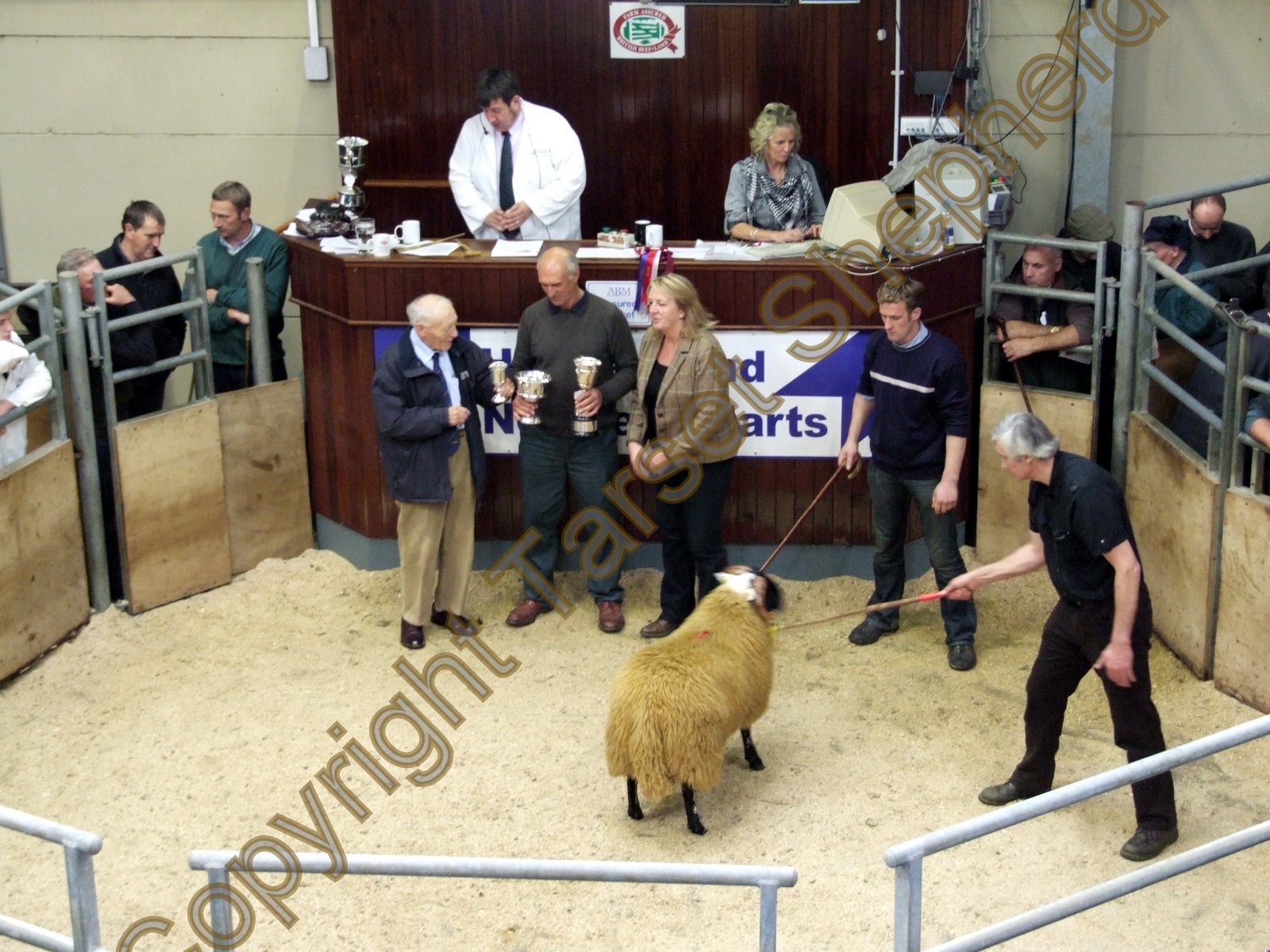
I actually wasn't quite on parr on the day (very sad I know!!) but did manage a wander around the pens and a bit crack around the ringside. There were some good sheep on offer. Scotch blood was apparent in some of them there is no doubt but there were still plenty of the traditional Hexham type on show too. The trade was selective to say the least but I'm sure the sales report will read well. The champion of the day went to Ian Davidson of Bennetsfield, seen above receiving his silver ware
  The tup lamb which was sold towards the end of the sale realised £2,000. The top price of the day being £10,000 for a shearling off Robert Raine, Townfoot.
  This shearling off Carrick realised £7,000, it was one of the first prize group of three which saw Caroline Hunter of Carrick being presented with the Willie Armstrong Memorial Shield, given in memory of her late father, it must have been a very proud moment for her.
 Selby Robson of Yatesfield sold the above sheep for £5,000.
All in all the day came and went. I did have quite a long crack with a retired shepherd off the scotch side, a noted blackfaced man in his hey day with an amazing knowledge of sheep, a man who broke all records for blackfaced tup prices way back in the '50's (long before shep's time!)and a man who said he could see a huge improvement in the Hexham tups. There are those who would disagree - staunch loyalists to the traditional type. However, it is all a matter of horses for courses, there was plenty variety and choice so there should have been something to suit everyone.
"You need a filing" said the dental receptionist.
"when would be convenient?"
"11th October" was my reply. This was met with raised eyebrows, but hey! the tooth was no bother and I knew I'd be in Hexham on the 11th October coz it's the tup sale day, 'tis always on the second monday of the month. Daresay I could have made an appointment sooner but what was to say it wouldn't be a good day and I'd need to get on with something to earn money to pay for the darned filling??
So. The first appointment of the morning was mine, followed by the tup sale. I missed the judging and the beginning of the sale, I couldn't speak, eat or drink for hours then took toothache and had to find some kindly farmers wife with a hand bag to seek out pain killers - but I survived!!! (never have liked the dentist!)
I actually wasn't quite on parr on the day (very sad I know!!) but did manage a wander around the pens and a bit crack around the ringside. There were some good sheep on offer. Scotch blood was apparent in some of them there is no doubt but there were still plenty of the traditional Hexham type on show too. The trade was selective to say the least but I'm sure the sales report will read well.


All in all the day came and went. I did have quite a long crack with a retired shepherd off the scotch side, a noted blackfaced man in his hey day with an amazing knowledge of sheep, a man who broke all records for blackfaced tup prices way back in the '50's (long before shep's time!)and a man who said he could see a huge improvement in the Hexham tups. There are those who would disagree - staunch loyalists to the traditional type. However, it is all a matter of horses for courses, there was plenty variety and choice so there should have been something to suit everyone.
Subscribe to:
Posts (Atom)
About Me

- Tarset Shepherd
- Tarset, Northumberland
- A peculiar individual by my own admission. One who has been compared (character wise) with a cheviot ewe!